Soundstalker Expeditions
Free Sample Lesson
This is a free sample from Soundstalker Expeditions. You’ll experience the Expedition Base and all Paths that make up a complete lesson — Material Science, Cultural Systems, and the Transformational Impact Path. There is also a References & Resources page.
Expedition Base
Lesson 1: The Voice That Travelled
How do you send a message when your voice can’t carry it?
Elias Soundstalker – ‘ES’: “What distinguishes human beings from other species? Take a moment. What would you say?”
“Human beings solve problems. Not always elegantly. Not always quickly. But creatively — with whatever they have, wherever they are.”
“My name is Elias Soundstalker. In this program, we undertake expeditions to explore the greatest problem-solving achievements in human history — and to understand the patterns that make them work. The scholarship behind these expeditions runs deep. You’ll find the names above worth knowing.”
“Our first expedition takes us into The Distance Problem. How do you send a message when your voice can’t carry it? When a runner can’t get there fast enough? When the message must be private — or when it must be heard by everyone at once?”
“Engineers have been working on this problem for thousands of years. You’re about to examine one of their greatest solutions.”
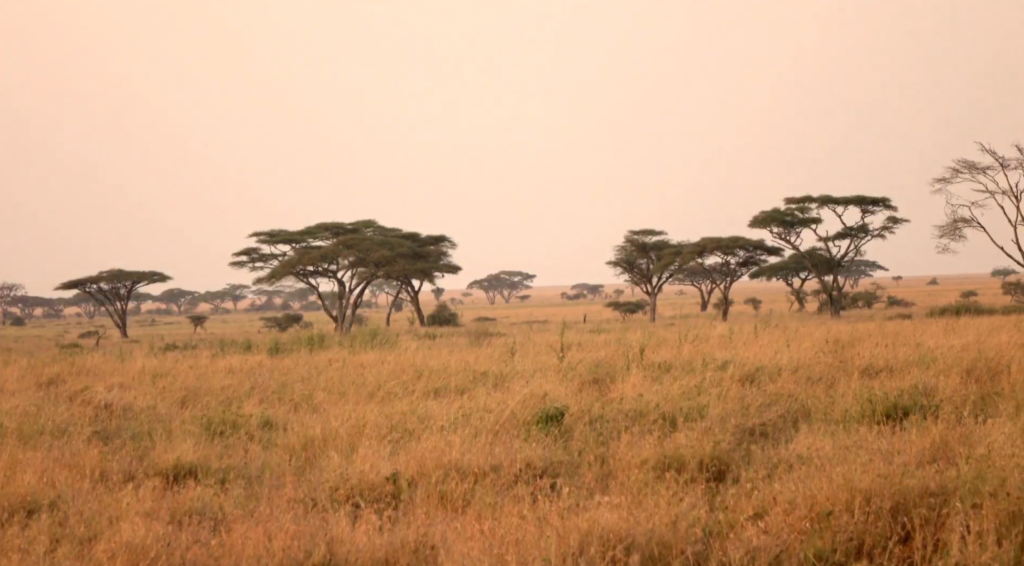
ES: “Look at this landscape. Imagine you need to send an urgent message — right now — to someone on the other side of the horizon. You have no mobile phone. No infrastructure. No radio. Nothing but what this land provides. What do you do? The forests and savannahs of West Africa stretch for thousands of miles. The challenge isn’t just distance — it’s scale.”
“For thousands of years, these people have been living here. Trading. Competing. Creating. And — like any group of neighbors — they didn’t always get along. They disagreed over resources, land, water, power. But out of that friction came something extraordinary: exchange. The Akan mastered gold. The Hausa controlled trade routes across the Sahara. The Yoruba built city-states. The Mandé became renowned storytellers and musicians.”
In the animation below, use your mouse to drag the map and scroll to zoom in or out. Click on the shaded areas on the map for more details-
ES: “These people didn’t just trade goods. They traded ideas. They traded technologies. They traded solutions. A good field scholar looks at this map and doesn’t just see geography. They see a network of problems waiting for solutions. That’s exactly how you should look at it right now.”
“The solution to the Distance Problem was one of the most brilliant results of that long, intricate conversation.”
“Before I show you what they built — think about what YOU would have reached for. Put yourself in West Africa. You have resources: forests and animals. You have skilled hands and accumulated knowledge. How would you solve it?”
“They built a tool. A membrane of goat skin — chosen for its specific acoustic properties. A shell of hardwood, carved into an hourglass shape to focus and project sound. A system of tension cords that allowed the operator to change the pitch in real time with a squeeze of the arm. Notice what they didn’t use. No metal. No electronics. No infrastructure of any kind. Every material chosen for a specific acoustic purpose. That’s not just craftsmanship. That’s engineering.”
ES: “What they made was not a musical instrument that happened to carry messages. This was a communication technology. Engineered. Intentional. Sophisticated enough that the people who feared it eventually wrote laws against it.”
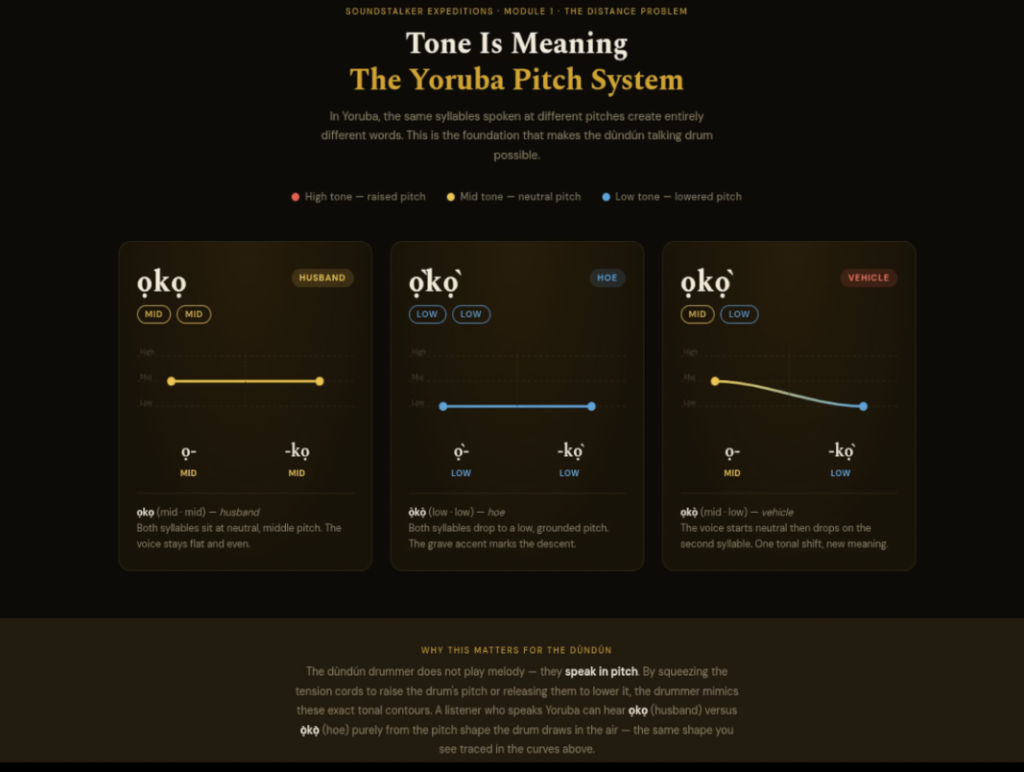
“Now here’s where it gets remarkable. The stroke of genius was pairing this technology with the tonal structure of the local language. Many West African languages, like Yoruba, are tonal — change the pitch of a word, and its meaning changes entirely.
ES: “Think about what that means for a drum that can change pitch in real time. It can replicate the acoustic signature of speech. Check this out… “
ES: “Did you catch what he did there? Did you notice how tightly the drum emulated his words? That was not just a rhythm pounded on a drum. That was a sentence. A clear statement. A declaration of triumph, stated for all to hear.”
“You just watched 3,000 years of material science, cultural exchange, and human need collide in 22 seconds — assembled into a solution — and you understood it. That’s not an accident. That’s what happens when you approach a problem with the right questions.”
“And we’ve only scratched the surface. This tool didn’t just carry messages. It carried armies. It coordinated revolts. It was so effective that empires actually banned it.”
“How? That’s what you’ll discover.”
“Three paths. One thread. Follow them in order — and here’s why the order matters.”

“Start with the Material Science Path. Before you can understand what the dundun does, you need to know what it is — down to the physics. How does tension alter frequency? How does the shape of the shell create resonance? Why does vibration become speech? Take the machine apart first. Understand every piece. And why it exists. Then the rest of the story makes sense.”

“Next — the Cultural Systems Path. This is where the story gets complex, and I want to give you a warning: it’s easy to get lost in it. The history is rich, the kingdoms are extraordinary, and the stories pull hard. Follow them — but keep one hand on the thread back to the first Path. The physics didn’t change. The people did. And that’s the whole point.”

“Finally — the Transformational Impact Path. This is where you bring it all together. Material science. Cultural systems. Human need. When those three collide — that’s where innovation lives. That’s where the pattern becomes clear. That’s where you become a Soundstalker.”
ES:
“The Soundstalker’s question for this lesson: What does it take to turn wood, skin, and cord into a language — and why would an entire civilization build it?”
“The dundun is one answer to the Distance Problem. It won’t be the last one you encounter.”
“The expedition awaits.”
Download this Path as PDF (M1L1-EB.pdf)
 First,