Soundstalker Expeditions
Free Sample:
Transformational Impact Path
Lesson 1: The Voice That Traveled
How do you send a message when your voice can’t carry it?
ES: “You’ve taken this tool apart down to its collagen fibers. You know why goat skin and not cowhide. You know the mathematics of the hourglass shell. You know the physics of a membrane under tension.”
“And you’ve traced it across 3,000 years. You’ve watched it move through kingdoms, carry royal commands, hold together trade networks that stretched across a continent. You understand what it is — a tool. Engineered to solve the Distance Problem. One of the most consequential problems in human history.”
“Now I want you to do something harder.”
“Before I show you what people actually did with this technology — I want you to think about what you would have done with it. Not as a musician. Not as a scholar. As someone with a problem, a deadline, and a drum.”
[Write your response here]
The drum travels. Empires tremble. The world changes.
ES: “A technology this powerful doesn’t stay in one place. It doesn’t stay in one century. It doesn’t stay in one purpose. The question this path asks is simple: What happened when this tool met the real world?”
“And what you’ll discover is a pattern. Not just the story of a drum — but a pattern that shows up everywhere, in every century, whenever a powerful tool meets human need, human courage, and the right moment in history.”
“The expedition isn’t over. It just got more interesting.”
Activity 1: The So What? Challenge
ES: “Before we go any further — I want to hear from you.”
“You now know that this tool can carry a spoken sentence across kilometers of open savannah. That a trained player can encode messages that sound like music to anyone who doesn’t share the language. That different ethnic groups across West Africa adapted it independently for different purposes — governance, trade, ritual.”
“So.
“Imagine you are an enslaved Akan warrior, taken from the Gold Coast and brought to Jamaica in 1750. You are on a plantation with three hundred other people from six different ethnic groups. You share almost no common language. The overseer watches everything. The plantation owner has muskets.”
“You have a drum.”
“What do you do with it?”
Note:
Write your answers in the boxes below. When you’re finished, be sure to click Submit at the bottom so your work is saved and your parent can review it.
M1L1.TI-A1-Notes
Activity 2: When the Tool Met the Empire
ES: “Three collisions. Three moments when drum culture met something entirely different — oppression, empire, plantation slavery — and something no one expected emerged.
These aren’t drum stories. They’re decision stories. The drum was just one element. The decision was what mattered.”
“Before each story, I’m going to give you the context. Your job: predict what the drum enabled — before you read what actually happened.”
“April 7, 1760. Jamaica. Before you read what happened — here’s what you need to know.”
“A man named Tacky was born a paramount chief on the Gold Coast of Africa. He was taken captive, sold, transported across the Atlantic, and placed on a plantation in Jamaica. He was a warrior before he was a slave. His lieutenants had been warriors too.”
“They understood coordination. They understood timing. And the plantation owners hadn’t thought to take the drum away from them.”
“You’ve already predicted what you would do in this situation. Now: what do you think Tacky did?”
M1L1.TI-A2a-Notes
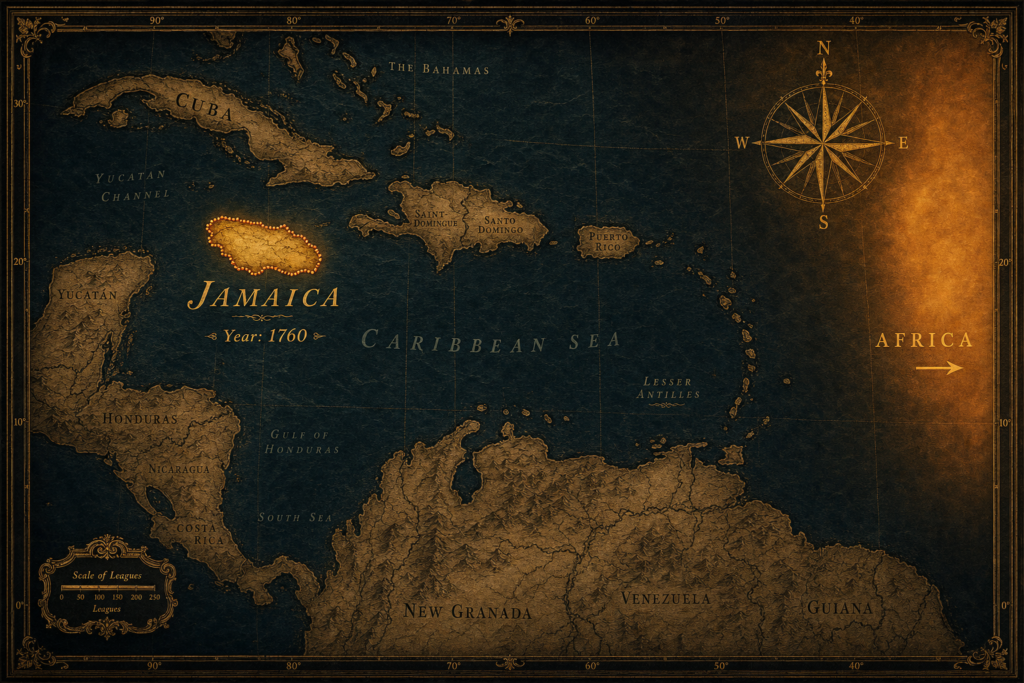
READING 1: The Revolt That Proved the Tool’s Power — Jamaica, 1760
Tacky’s Revolt was not a desperate, disorganized uprising. It was a coordinated military campaign — planned by men who had led armies in West Africa before being transported across the Atlantic.
Harvard historian Vincent Brown, in his landmark study Tacky’s Revolt: The Story of an Atlantic Slave War, argues that this rebellion was simultaneously four wars at once: a fight for freedom against white slave owners, a territorial struggle among Black communities, a continuation of African political conflicts, and a battle entangled in the global Seven Years’ War between Britain and France. Historian Trevor Burnard wrote that “only the American Revolution surpassed Tacky’s War in the eighteenth century” in terms of its shock to the imperial system. “
Drum messages traveled between plantation centers spread across Jamaica’s northern parishes, carrying encrypted communications that slaveholders could not intercept or decode — because the messages were encoded in tonal patterns that required fluency in West African musical languages to understand. The revolt lasted eighteen months before suppression.
The British response was swift — and revealing. After the revolt was finally suppressed, the Jamaican colonial legislature moved to formally ban drumming among enslaved people. They were not alone. Similar prohibitions appeared across the colonial Caribbean and American South: Barbados in 1688, St. Kitts in 1711 and 1722, South Carolina’s Negro Act in 1740.
Write that down: Governments do not ban ineffective tools. When an empire passes a law against a drum, it is confessing — in writing, with a legal seal — that the drum worked.
Tacky’s Revolt failed. Over 1,100 rebels were killed. Tacky himself was killed. The British reimposed control.
But the drum — and the people who played it — did not disappear.
ES: “I want you to sit with that for a moment. … They lost. After eighteen months of fighting, they lost. And the first thing the colonial government did afterward was pass a law against drumming.”
“That law is not the story of a defeat. That law is a receipt. Proof that the drum had done exactly what it was designed to do.”
“The drum didn’t win that day. But something important survived.”
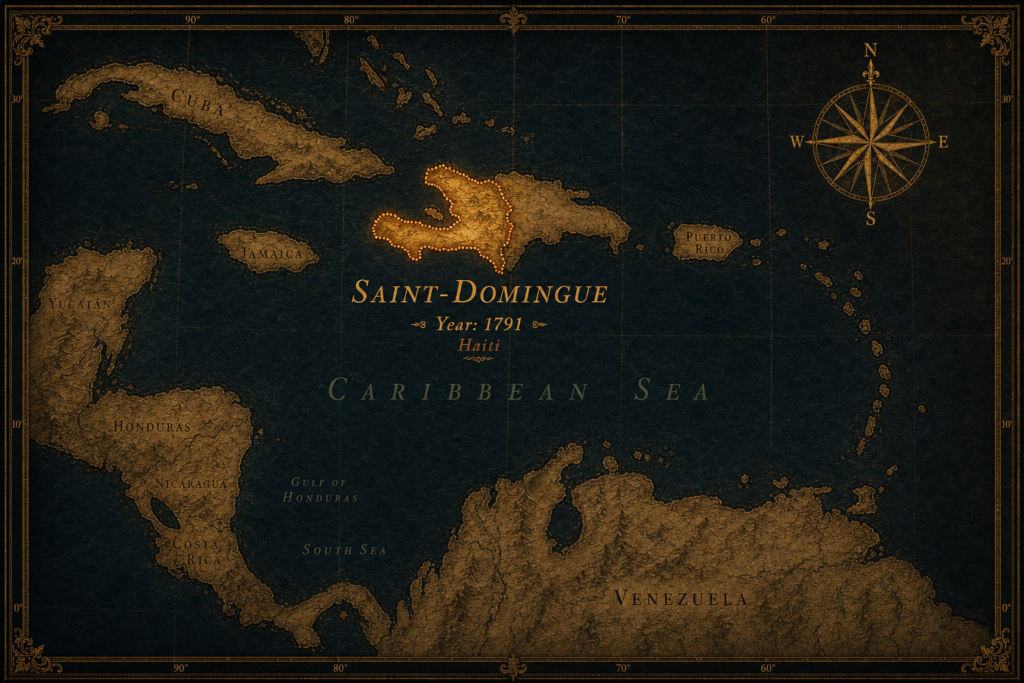
ES: “Thirty-one years later. Different island. Different generation. Same technology.”
“The French colonists in Saint-Domingue allowed Vodou gatherings — including drumming — as a safety valve. A tolerated outlet. They thought they understood what the drums were.”
“They did not.”
“Before you read what happened: what do you think they missed?”
M1L1.TI-A2b-Notes
READING 2: The Night That Changed the World — Saint-Domingue, 1791
August 14, 1791. A place called Bois Caïman — “Alligator Wood” — a forested hillside in the north of the French colony of Saint-Domingue, the richest sugar producer in the world.
Two hundred enslaved Africans. A driving rainstorm. Drums.
The ceremony was led by Dutty Boukman — a Jamaican-born Vodou priest — and Cécile Fatiman, a Vodou priestess. As drums pounded through the rainstorm, the assembled men and women swore an oath of solidarity and planned the uprising that would become the Haitian Revolution.
A note on the historical record: The only contemporary written account of the Bois Caïman ceremony was recorded by Antoine Dalmas — a white colonist — writing in 1793, more than two years after the event, and published in 1814. The details have been retold and expanded over generations. What is not disputed is what happened next.
Within a week, on the night of August 21–22, the northern plain of Saint-Domingue erupted.
Thousands of enslaved men and women rose simultaneously across plantations that had been carefully coordinated in advance. Within months, the rebellion had grown into a full revolution. By 1804, thirteen years after that rainy night in Alligator Wood, Haiti had become the first free Black republic in history — the only successful slave revolt to produce a lasting independent nation.
The ceremony at Bois Caïman served three functions simultaneously: it was a religious ritual binding the participants spiritually; it was a strategic meeting coordinating timing and targets; and it was a communication event — the drum calling people together across distance, encoding the rhythm of resistance in a language their oppressors could not read.
Before Bois Caïman, Vodou gatherings — including their drumming — had been permitted by white slaveholders as a safety valve — a tolerated outlet. They did not understand what the drum was doing. They had not read the lesson the Jamaicans wrote in 1760.
Write that down: The most dangerous moment for a controlling power is when it mistakes a tool of resistance for a harmless tradition.
By the time they did, it was too late.
ES: “Haiti exists. That is the evidence. The first free Black republic in the Western hemisphere, born from an uprising coordinated by drum — against the army of Napoleon Bonaparte, the most powerful military force in the world at that time.”
“The conditions in Saint-Domingue in 1791 were different from Jamaica in 1760 in ways that mattered: the numerical ratio of enslaved to enslavers was higher, the revolutionary ideology of France had fractured colonial authority, and the leadership that emerged from Bois Caïman was more unified and more strategically sophisticated than Tacky’s network.”
“Same tool. Different conditions. Different outcome.”
“Tools persist. The people who use them determine what they become.”
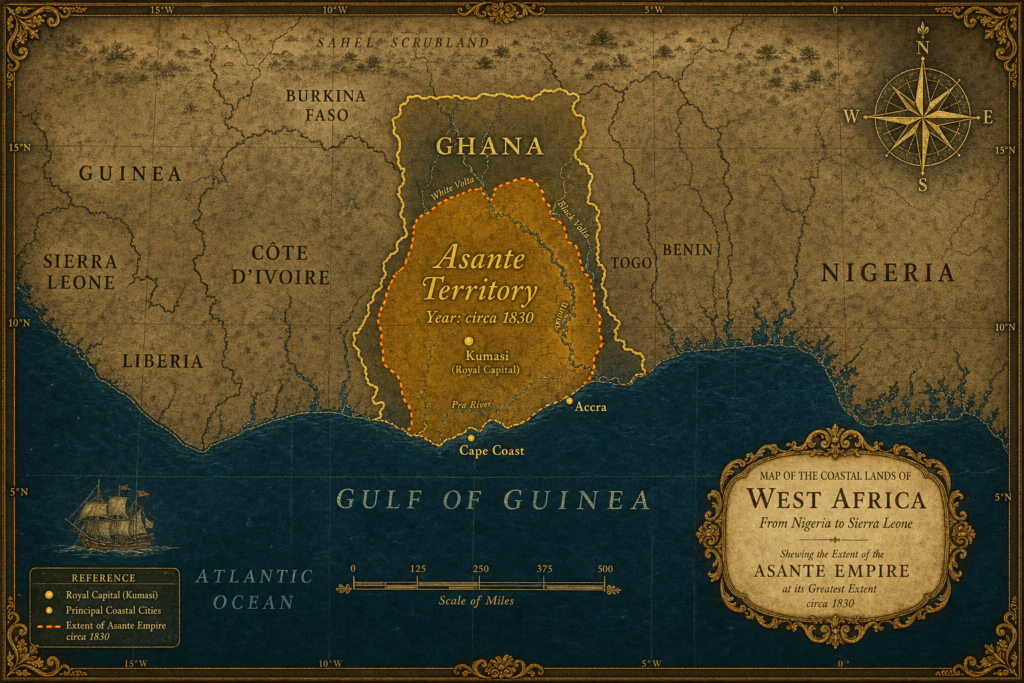
ES: “The drum didn’t travel only across the Atlantic. It stayed home in Africa, too. And at home, it met the British Empire.”
“The British had the telegraph — the most advanced long-distance communication technology in the world at that time. The Asante had forest. Dense, humidity-killing, visibility-destroying forest. Terrain where European military tactics failed.”
“Which side had the communication advantage? Write your prediction before you read.”
M1L1.TI-A2c-Notes
READING 3: The Forest That Talked Back — West Africa, 19th Century
The Asante Empire at its 19th-century height controlled a territory in what is now Ghana, larger than modern-day England. The British Empire was expanding into the region, backed by industrial military logistics and — crucially — the telegraph. The most advanced long-distance communication technology in the world.
They fought in the forest—thick, wet, and blinding—exactly the kind of ground where European-style warfare broke down. Where columns got lost. Where the telegraph hadn’t reached.
The British had industrial communication. The Asante had something older — and in this terrain, something better.
The talking drum.
The Asante had standardized a talking-drum language across their entire polity. Drum tones mimicked Twi speech patterns, understood by trained listeners throughout the empire. Messages could be relayed from town to town, from command to unit, through jungle so dense it choked British signals but could not choke the drum. This was not improvisation. It was infrastructure — as deliberately designed and organized as the British telegraph network, but built on different principles for different terrain.
The result: Asante forces could coordinate ambushes, summon reinforcements, and relay intelligence faster than the British could move through the forest. The British could hear the drums. They couldn’t understand them. The Asante had, in effect, encrypted military communication — a century before modern cryptography.
The British eventually won — not by breaking the drum code, but by bringing overwhelming force and extending the telegraph and railroad into Asante territory. They defeated the Asante communication system by building their own.
Write that down: You don’t have to break an opponent’s system to win. You can build a better one. But until you do — the system you can’t crack will hold.
But for decades, the talking drum gave the Asante something remarkable: the ability to fight the world’s most powerful empire to a standstill in their own terrain, using infrastructure that empire couldn’t read.
ES: “Three stories. Jamaica. Haiti. Asante. Different centuries, different outcomes. The Jamaican revolt was suppressed. The Haitian Revolution succeeded. The Asante fought a drawn-out war before ultimately losing the political contest.”
“But look at what all three have in common.”
“In every case, the drum enabled coordination that the opposing power could not predict, intercept, or replicate without first building their own communication infrastructure. In every case, the drum turned the Distance Problem from a liability into an advantage — for people who, by every material measure, should have been powerless.”
“The physics of the membrane didn’t change. The shape of the shell didn’t change. The trade-off between elasticity and durability didn’t change.”
“What changed was the collision. The moment when the tool met the people who needed it most.”
| Jamaica, 1760 | Haiti, 1791 | Asante, 19th c. | |
|---|---|---|---|
| Material Possibility | |||
| External Element | |||
| The Decision | |||
| Impact | |||
M1L1.TI-A2d-Notes
Activity 3: The Long Return — and The Lens
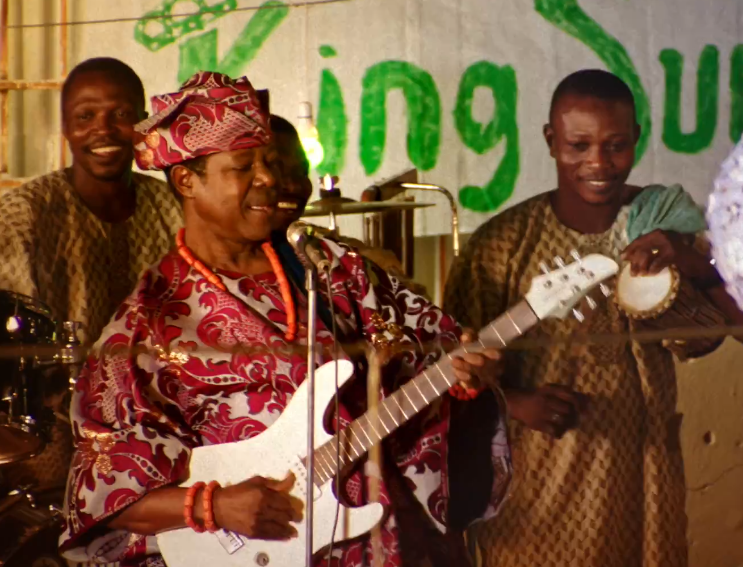
ES: “1982. New York City. A Yoruba musician named King Sunny Adé walks onto a stage at Carnegie Hall. In his hand, a guitar. Behind him, a dundun player.”
“He’s not playing a revival. He’s not playing nostalgia. He’s playing the future.”
READING: When the Tool Became an Industry
The Distance Between Lagos and Carnegie Hall
King Sunny Adé didn’t invent Jùjú music — the Yoruba guitar-and-percussion style that blends talking-drum traditions with electric instruments and steel guitar. But he transformed it.
In the late 1970s, Adé signed with a small Lagos-based label, built his own sound system, and began playing to enormous audiences across Nigeria and West Africa. Then, in 1982, he signed with Island Records — the international label that had broken Bob Marley globally a decade earlier — and released Juju Music for international markets.
The album was a sensation. The New York Times wrote that it fused “past and present” with an “intoxicating” energy that felt simultaneously ancient and completely contemporary. Western critics who had never heard Jùjú music before found themselves mesmerized by something they couldn’t quite classify.
At the center of the sound was the dundun.
Not as an ethnographic curiosity. Not as a world-music novelty. As a living instrument in a living music, doing what it had always done — carrying tonal information, bending pitch in real time, encoding the rising and falling speech patterns of Yoruba — but now in dialogue with electric bass, talking to a global audience.
Adé was not preserving a tradition. He was demonstrating that the tradition was still alive, still generative, still capable of producing something new.
The Pattern You Now Recognize
Let’s name what happened.
A communication technology, engineered 3,000 years ago from goat skin and hardwood. Banned by colonial powers in the Caribbean because it was too effective. Carried across the Atlantic by enslaved people who used it to coordinate revolts. Survived suppression. Found new contexts in music, education, and cultural identity. And then — in 1982 — crossed another distance entirely: from a local Yoruba tradition to an international music market, earning a Grammy nomination and introducing millions of listeners to a technology they had never heard of.
The physics of the membrane didn’t change.
The tool’s reach expanded every time someone decided to bring it into a new context.
Write that down: This is what tools do when they are built to solve fundamental problems. They don’t become obsolete. They find new applications. They are not replaced — they evolve.
M1L1.TI-A3-Notes
Transformational Impact Path — Close
A Note from Elias Soundstalker:
“You came asking about a drum.
What you’ve actually studied is a problem. The Distance Problem. One of the oldest and most fundamental challenges in human civilization. How do you make yourself understood when the world — geography, noise, oppression, language, distance — conspires to silence you?
This tool was one answer. Engineered from goat skin and hardwood and the physics of vibration, refined over 3,000 years, adapted to dozens of languages, powerful enough that empires passed laws against it.
The tool persists. The problem persists. The pattern persists.
You now carry The Soundstalker’s Lens. Every technology you encounter for the rest of your life has a material science story, a cultural systems story, and a transformational impact story. You’ve learned to find all three.
The expedition is complete. But the Soundstalker continues. Watch for the collisions. Ask the questions.
Happen to the world. Lesson 2 is waiting…”
 Next,
Next,
Link to Parent/Teacher Guide